


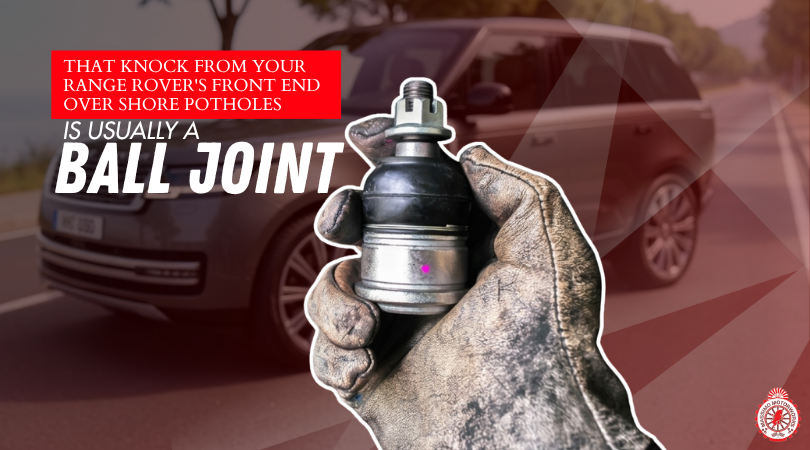
The first cold week of October is when owners call about it. You hit the same broken patch on Route 36 you have taken all summer, and now the front end answers with a deep knock instead of a thud. The steering has gone lazy too, though you would struggle to say when that started.
On a Range Rover, Range Rover Sport, Discovery or LR4, that knock is usually a worn ball joint — the one front-end part that carries the full weight of the truck and steers it at the same time. And unlike a bushing, it does not stay a noise complaint forever.
Quick Summary: Key Takeaways
- What a ball joint does: It is the pivot that lets each front wheel steer and move up and down at once, carrying the weight of the truck through a socket the size of a golf ball.
- The tell: A deep single knock over sharp bumps from one front corner, plus steering that has lost its precision.
- The cause is usually the boot: Once the rubber boot splits, grease escapes, water and shore-road salt get in, and the socket wears fast from there.
- It is measurable: Play at the knuckle is checked with the wheel off the ground and a pry bar, so this is not a judgment call.
- Do not wait it out: A ball joint is the rare front-end part that can separate outright, and when it does the wheel folds under the truck.
One socket carries the weight and does the steering
A ball joint is a hardened steel ball in a lined socket, packed with grease and sealed by a rubber boot. It ties the control arm to the steering knuckle, so it lets the wheel pivot left and right while the suspension moves up and down, all while carrying a share of a vehicle that weighs well over two tons.
Nothing about it is exotic. What changes on a Land Rover is the load: heavy, tall, and built to carry people and cargo, which is why the lower joints go first.
On several of these platforms the lower joint is built into the control arm, so the arm comes out as an assembly. That sounds worse. It is often better, because you get a fresh bushing at the same time.
The noise comes from one corner over one kind of bump
Ball joint knock is deeper and duller than a sway bar rattle, and it happens over sharp edges rather than long undulations. Pothole lips, manhole covers, the ridge where a repaved lane meets an old one. One corner, one knock.
Owners describe the second symptom as the truck feeling tired: small constant corrections to hold a lane on the Parkway, less connection just off center, and a vehicle that now follows ruts it used to ignore. That is slop showing up in the geometry.
Then check the inside tread. A worn joint shifts camber under load, so the inner shoulder wears faster than the rest of the tire. Feel it with your hand.
Play at the knuckle is measured, not guessed
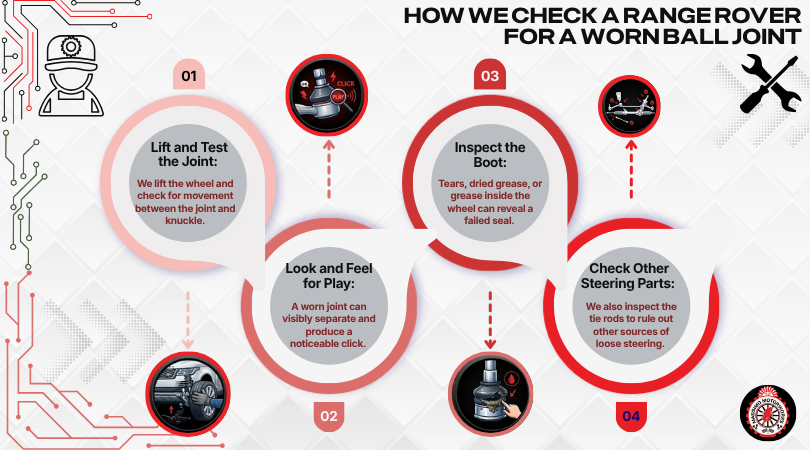
With the wheel off the ground, a technician levers between the control arm and the knuckle and watches the joint. A healthy one does not move. A worn one separates visibly between stud and housing, and you can feel the click as it takes up the slack.
The boot tells the rest. Split rubber, dried grease, or a greasy film on the inside of the wheel means the seal went a while ago and the socket has been grinding on road grit since. Once that happens the joint is finished, whatever it measures today.
We check the tie rod ends in the same pass. Loose steering has more than one source, and the wrong part changes nothing.
Monmouth County roads and salt air finish them off
Shore roads punish ball joints twice over. The pavement between Long Branch, Shrewsbury and Red Bank breaks up in freeze-thaw cycles that start in earnest this month, and salt air works on every rubber boot underneath the truck year-round.
The cost side is documented. Driving on roads in need of repair costs each New Jersey driver $713 per year, according to ASCE’s 2025 Infrastructure Report Card — and a truck with a dry ball joint absorbs that surface far worse than one with a good one.
Off-season traffic changes things too. The summer crawl along Ocean Avenue was gentle. Now you are driving that broken surface at speed, and a marginal joint starts making itself heard.
A separated ball joint does not give you a second warning
Most front-end wear items get louder for months and then get replaced. A ball joint is different. When the socket wears through, the stud pulls out of the housing and the wheel folds under the vehicle with no warning.
It is rare. It is also why nobody should wait this one out. If a passenger has commented on the knock, the truck needs inspecting this week.
But the cheaper argument is tires. A worn joint scrubs the inside edge of a front tire, and on these trucks a set costs more than the arm.
Why Land Rover owners bring the knock to us
Massimo Bottino has been a certified master technician since the early 2000s, and this shop built its name on high-end European and exotic work at two Monmouth County locations. Ball joints are unglamorous. They are also the kind of job where a guess costs you a second visit.
New arms go in torqued at ride height, then we road-test over the same pavement that produced the noise.
Frequently Asked Questions
Q: What does a bad ball joint sound like on a Range Rover?
A: A deep, single knock from one front corner over sharp bumps, sometimes with a creak when you turn at very low speed. It is duller than a sway bar rattle, and it usually arrives with steering that feels less precise just off center.
Q: How long can you drive with a worn ball joint?
A: Not long, and we will not put a number on it. Wear accelerates once the boot tears, and unlike most suspension parts a ball joint can separate completely. If you hear it clearly from inside, get it measured now.
Q: Do you have to replace the whole control arm for a ball joint?
A: On several Land Rover platforms, yes. The lower joint is built into the arm as an assembly, which gives you a new bushing at the same time. Where the joint is separate, we replace just the joint.
Have the front end checked before the first freeze
A knock in October is an arm and an afternoon. In February it is the same arm plus seized hardware and a lot more labor. Tell us which corner talks, and over what kind of bump.
Massimo Motorworks – 208 Clinton Pl, Long Branch, NJ 07740
Shrewsbury location – 430 Broad St, Shrewsbury, NJ 07702
Website: massimomotorworks.com