


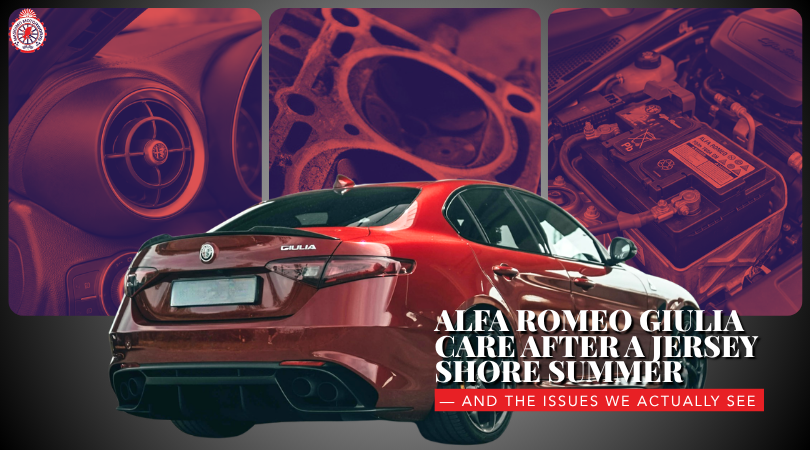
A Giulia is a genuinely good car that asks for attention. Owners who give it that attention drive them for years. Owners who treat it like an appliance end up with a dash full of amber lights the week after Labor Day, usually in Ocean Avenue traffic with the AC still struggling.
We service Alfa Romeo at both our Long Branch and Shrewsbury shops, and the end-of-summer pattern is consistent: carbon buildup on higher-mileage 2.0-liter turbos, batteries cooked by three months of heat, and air conditioning that quit the first week it hit 90. All three are predictable, and all three are cheaper caught early.
Quick Summary: Key Takeaways
- Halve the oil interval: change the 2.0-liter turbo’s oil every 5,000 miles rather than the 10,000-mile book figure.
- Carbon buildup is normal, not a defect: direct injection leaves deposits on intake valves, typically noticeable by 60,000 miles.
- Battery drain gets misdiagnosed: a weak battery or a body module staying awake causes faults that look electrical and random.
- The AC condenser sits exposed: front-mounted and vulnerable to road debris and Shore salt air, and it is the failure that turns up most once the heat lets go.
- Tire pressure moves with temperature: pressure changes roughly 1 psi for every 10-degree swing, so check cold, monthly.
Giulia complaints cluster around heat and electronics after a Shore summer
Three categories cover most of what rolls in. Heat-related failures like the AC condenser and compressor, electrical faults traced back to battery voltage, and drivability issues from carbon and ignition wear on the 2.0-liter turbo. The Quadrifoglio’s 2.9-liter twin-turbo V6 brings its own list, mostly around cooling and oil service.
The car isn’t fragile. Alfa’s published maintenance schedule is simply optimistic for a Giulia driven hard through a Jersey Shore summer, and the owners who tighten those intervals end up with a very different ownership experience. Do that and the Giulia rewards you.
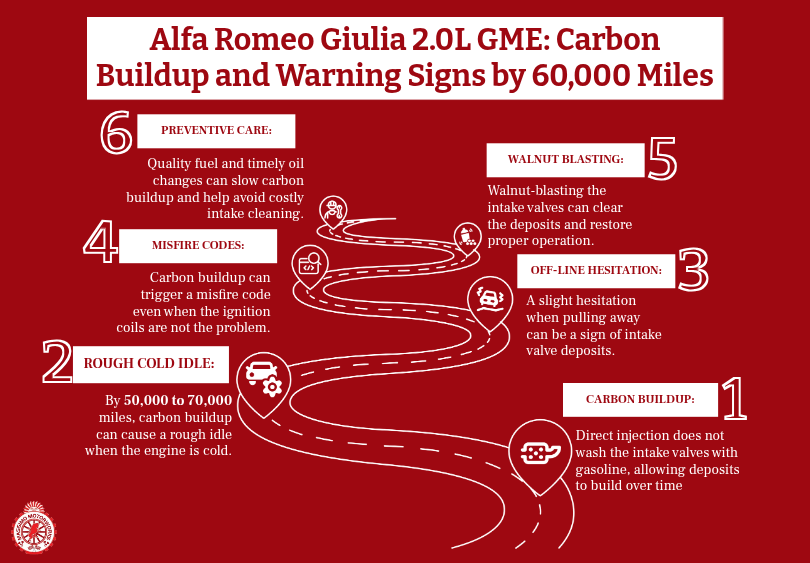
Direct injection leaves carbon behind by 60,000 miles
The 2.0-liter GME turbo sprays fuel directly into the cylinder, so no gasoline washes over the intake valves the way it did on port-injected engines. Deposits build. By 50,000 to 70,000 miles you’ll often feel a rough cold idle, a slight hesitation off the line, or a misfire code that has nothing to do with the coils.
Walnut-blasting the intake valves clears it, and it’s worth asking any shop whether that work happens in-house or goes out. Ask before you book. Quality fuel and oil changes on time slow the buildup in the first place, which is far cheaper than paying someone to pull an intake manifold and blast the valves clean at 80,000 miles. If your Giulia idles rough past 60,000 miles, ask to have the intake looked at before anyone sells you coils.
Battery drain gets blamed on the wrong parts
Voltage is the first thing worth checking. A Giulia running on a battery at 11.8 volts throws warnings across systems that have nothing wrong with them — parking sensors, lane assist, start-stop, even the electronic parking brake. Owners then spend money chasing modules when the fix was a battery.
Genuine parasitic drains do happen, usually a module that won’t sleep or an aftermarket accessory wired badly. Finding one takes a current-draw test over several hours, so ask whoever quotes the job whether that’s what they’re doing or whether they’re guessing at parts. Ask about battery registration too. That step gets skipped constantly, and an uncoded battery gets cooked by the charging strategy.
Giulia AC failures usually start at the condenser
The condenser sits at the very front of the car. That location makes it efficient and also exposes it to stone chips, bug debris and the salt-laden air off the ocean, which is why Shore cars weep refrigerant early. Rinse the front end regularly.
Symptoms are easy to read: cold air that fades in stop-and-go traffic, then goes lukewarm on the hottest day of the year. We check pressures on both sides, dye-test for leaks, and inspect the compressor clutch before recommending anything.
Shore heat and salt air justify a tighter service schedule
Our recommendation for a Giulia at the Shore looks like this: oil every 5,000 miles with the correct 0W-30 specification, cabin and engine air filters annually, and brake fluid every two years. The ZF 8HP automatic also wants a fluid service somewhere around 60,000 miles rather than never, so put that on your list and ask about it. Coolant condition gets tested. Never assumed.
Tires deserve a monthly look. NHTSA notes that tire pressure changes by about 1 psi for every 10-degree change in ambient temperature, so a set aired up on a 95-degree August afternoon reads low on the first 50-degree morning in October. Check them cold.
Long Branch and Shrewsbury Alfa owners have a local option
Alfa needs a specialist, not a dealer badge. Master Technician Massimo Bottino has worked on high-end European and exotic cars here since the early 2000s, and both locations handle Alfa alongside Audi, BMW, Jaguar, Land Rover, Mercedes and Porsche. Factory-scheduled maintenance is where most of it starts.
You get a straight estimate and a clear list. No mystery line items. We’ll tell you what needs doing before winter and what can sit until spring. Get it on the schedule.
Frequently Asked Questions
Q: How often should you change the oil in an Alfa Romeo Giulia?
A: We recommend every 5,000 miles on the 2.0-liter turbo, even though the manual allows longer. Turbocharged direct-injection engines in stop-and-go Shore traffic are hard on oil, and shorter intervals are the cheapest protection you can buy for the engine.
Q: What are the most common Alfa Romeo Giulia problems?
A: Battery and electrical faults tied to low voltage, carbon buildup on the intake valves past about 60,000 miles, AC condenser leaks, and coolant or thermostat housing seepage. Most are straightforward once diagnosed properly.
Q: Why does my Giulia show multiple warning lights at once?
A: Usually a weak battery or a charging fault. When system voltage sags, modules report errors they don’t actually have. Test the battery and the draw first, then register the replacement so the charging strategy matches.
Q: Where can I get an Alfa Romeo serviced in Monmouth County?
A: We service Alfa Romeo at our Long Branch and Shrewsbury shops — oil service, factory-scheduled maintenance, A/C repair, steering and suspension work, and timing belt service. Master Technician Massimo Bottino has worked on European cars since the early 2000s.
Book Giulia fall service at the Shore
Get the oil, the battery and the A/C handled now, while the weather is still easy. We’ll tell you exactly where your Giulia stands and what it needs first.
Hours: Monday – Friday: 8:00 AM – 5:00 PM, Saturday 8:00 AM – 1:00 PM
Website: massimomotorworks.com