



A rough idle in a Porsche feels wrong in a way that’s hard to ignore. These engines are engineered for precision — a silky, planted idle is part of what defines the Porsche driving experience. When that idle becomes uneven, stumbling, or accompanied by a loss of power on the Garden State Parkway or Route 36 through Long Branch, the MAF sensor is one of the first components that deserves a hard look.
The mass airflow sensor measures the volume and density of air entering the engine, feeding that data to the engine control unit to calculate the correct fuel delivery. When it fails or gives inaccurate readings, the ECU runs the engine on bad data — and the results show up quickly as rough idle, hesitation, reduced power, and a check engine light that keeps coming back.
Massimo Motorworks is Long Branch and Shrewsbury’s European auto repair specialist, serving Porsche owners across Monmouth County from our locations on Clinton Place and Board Street. Our technicians work on Porsche vehicles daily and have the diagnostic capability to distinguish a genuine MAF failure from the other issues that produce the same symptoms.
Symptoms of a Failing Porsche MAF Sensor
- Rough or unstable idle — the engine stumbles or hunts for a stable RPM at rest. On a Porsche, this is the most common and immediately noticeable symptom of MAF sensor degradation.
- Hesitation under acceleration — a flat spot or stumble when applying throttle from a stop or at partial load, particularly noticeable when merging onto the Parkway or accelerating through Eatontown.
- Reduced power across the RPM range — the engine feels less responsive than usual and doesn’t rev out as cleanly. On turbocharged Porsche models like the 911 Turbo, Macan, and Cayenne, boost delivery feels muted or inconsistent.
- Check engine light with lean or rich mixture codes — inaccurate MAF sensor readings cause the ECU to miscalculate fuel delivery, triggering codes like P0171 or P0172 indicating lean or rich running conditions. These codes are frequently misdiagnosed as fuel-system or oxygen-sensor faults.
- Poor fuel economy — an engine running on incorrect airflow data compensates by over-fueling or under-fueling, both of which reduce efficiency noticeably over the stop-and-go driving patterns common along the Jersey Shore corridor.
- Black smoke from the exhaust — in cases of significant MAF failure, causing rich running, unburned fuel produces visible black smoke, particularly on startup.
What Causes Porsche MAF Sensor Failure in Long Branch
- Contamination is the leading cause. The MAF sensor’s hot-wire measuring element is extremely sensitive to oil, dust, and moisture. Porsche owners who’ve run aftermarket oiled air filters — or whose air filter was improperly over-oiled during service — introduce oil mist directly onto the sensor element, coating it and reducing its accuracy over time. New Jersey’s coastal environment, with its salt air and humidity along the Long Branch waterfront, accelerates this contamination.
- Age and heat cycling — the sensor’s measuring element degrades through repeated heating and cooling cycles over high mileage. Most MAF sensors have a service life that aligns with other high-mileage maintenance items, and sensors on older Cayenne, Panamera, and 911 models are simply wearing out.
- Air intake leaks — a cracked intake boot or loose connection between the MAF sensor and the throttle body allows unmetered air to enter the engine, producing the same symptoms as a failed MAF sensor while the sensor itself is fine. Proper diagnosis distinguishes between the two.
Why Accurate Diagnosis Matters Before Replacing the MAF Sensor
MAF sensor symptoms overlap with 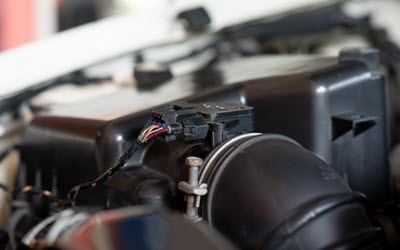 several other Porsche faults — oxygen sensor failure, fuel pressure issues, vacuum leaks, and dirty fuel injectors can all produce rough idle and lean/rich codes. Replacing a MAF sensor when the actual fault is a vacuum leak wastes money and leaves the real problem unresolved.
Massimo Motorworks uses Porsche-compatible diagnostic equipment to read live MAF sensor data and compare actual airflow readings against expected values at idle and under load. This approach confirms whether the sensor is genuinely failing or whether the symptoms are caused by another part in the intake or fuel system before any parts are ordered.
For Porsche repair and service in Long Branch, comprehensive check-engine-light diagnosis that finds the actual cause, and factory-scheduled maintenance performed to Porsche specifications, Massimo Motorworks is Monmouth County’s European specialist of choice.
Frequently Asked Questions About Porsche MAF Sensor Problems in Long Branch
Can I clean my Porsche’s MAF sensor instead of replacing it?
In some cases, yes — if contamination rather than physical failure is the cause, careful cleaning with MAF-specific cleaner can restore accurate readings. Massimo Motorworks will advise whether cleaning or replacement is appropriate based on the diagnostic findings.
How much does a Porsche MAF sensor replacement cost in Long Branch?
Cost varies by model. Massimo Motorworks provides a complete diagnosis and estimate before any work begins. Contact us through massimomotorworks.com or visit either our Long Branch or Shrewsbury location.
Which Porsche models most commonly have MAF sensor issues?
The Cayenne, Panamera, Macan, and high-mileage 911 models are the most common. Turbocharged variants are particularly sensitive to MAF accuracy given the added complexity of boost management.
Schedule Your Porsche MAF Sensor Diagnosis at Massimo Motorworks Today
Schedule online at massimomotorworks.com or contact us directly to get your Porsche diagnosed and back to running the way it should.